Monday, 23 November 2015

Survey Analysis


The Effects of Violence in Video Games on 16-18 Year Olds


Violence in Video Games:

Video games are becoming part of our everyday lives, especially in teenagers within the 16-18 year age bracket. With new releases such as Call of Duty Black Ops III due to hit the shelves, there are a lot of questions being asked about the amount of violence within games and how they effect the people playing them.

Audience Theory:

Hypodermic Needle Theory, or Magic Bullet Theory, is the theory of media controlling the minds of the audience.

Hypodermic Needle Theory promotes a few basic assumptions:

1. Humans react uniformly to stimuli.
2. The media’s message is directly “injected” into the “bloodstream” of a population like fluid from a syringe.

3. Messages are strategically created to achieve desired responses.

4. The effects of the media’s messages are immediate and powerful, capable of causing significant behavioral change in humans.

5. The public is powerless to escape the media’s influence.”


The above example gives the impression that after seeing, or hearing, violence will give the person violent temptations or urges. Originally developed in the 1920’s, Hypodermic Needle Theory is still looked at as the reason as to why people react in specific ways. It is disputed however, due to the difference within the audience. No one person reacts exactly the same as another when given the same resources.  Hypodermic Needle Theory focuses on enforcing the impression of brainwashing the audience, whether from playing a game, watching a film, reading a book or hearing a news article or song from the radio. The University of Rochester, New York, did an experiment to try and determine if violent games are bad for a person, or whether they help with cognitive motor skills.

"It's not the case that the action game players are trigger-happy and less accurate - they are just as accurate and also faster," said Daphne Bavelier, a cognitive scientist at Rochester who has been testing how computer games affect the brain and eyes for much of the past 10 years. "Action game players make more correct decisions per unit time. If you are a surgeon or you are in the middle of the battlefield that can make all of the difference."

Where the above statement doesn't reference violence, it gives the indication that games are a useful part of our everyday development. There is some dispute to this given that many violent acts are linked to have been inspired by what the accused had witnessed within the games they have played. One of the most famous cases of this was after the release of Grand Theft Auto: Vice City in 2003. The crime took place in Alabama and saw 18 year old Devin Moore shoot and killed two police officers, as well as the dispatcher and then proceed to steal a police car. Whilst in custody Moore told officers that "Life is a video game. You've got to die sometime."

 In 1974, theorists; Blumler J.G. and Katz, E. came up with the Uses and Gratifications Theory. The theory outlines different thoughts on why the individuals choose to seek out different types of media. It could be due to arousal, challenge, diversion, social interaction, fantasy or competition. 

Due to releases of software, such as Xbox Live or PlayStation Network, gaming for social purposes has become much more popular. Both of these pieces of software allow you to connect to the internet and play games with people from across the globe. 
There is a well known dispute of whether Xbox or PlayStation are the better console, some people tend to sway more towards PlayStation. The main factor of this is due to the online services for the PlayStation are free of charge on the PS3 Console, not on the newest (PS4) console.

Looking at the other elements of this theory, all seem to have a great argument as to why people play games. Starting with arousal, a lot of people play games to activate and stimulate their emotions. Which, also could link to the challenge of a game. Games are becoming more and more challenging, allowing the player to expand their skills as they play, often to escape their responsibilities or simply relax. This is where the division element of theory comes in to play.  All of the above link together, but also stick out as individuals also.

Reception Theory is the reaction to how a piece of media is received, in this case; how well a game is received. "There are two aspects of reception: the ways a person or event was portrayed (by the "multipliers" and makers of public opinion), and the ways those portrayals were perceived (by the populace at large). The portrayals are easiest to determine--they make up the historical record. However, we usually only have indirect indications of how those portrayals were perceived by individuals, and even more rarely how groups perceived them."

There are many ways to know how well a game has been received, the most popular way would be through reviews. Companies, such as IGN reviews every game and place the review on their website, which acts as a game review database.  Resources like this can also be reviewed by the general public giving an even greater vision into the reception of a game. Within the reviews on the sight you can see a verbal response of people who have played the games. Here gives you an insight into what people do and don't like about a game. 

Reception Study Theory is the theory of how the player will interpret the message of the game that they are playing. Some people may interpret different things in different ways, this could be why a player reacts to a certain situation in the way that they do. The reception and/or reaction to various aspects of a game can be seen as a healthy or an unhealthy reaction, dependent on the individual.


“An active consumption is when the audience will engage and discuss media messages that comes across to them and sometimes question the media messages through life experiences.”

“A passive consumption is when the audience doesn’t engage or question the media message but just accepts it, this what media outlets want to achieve when making a film or show as they want to view to except and not question.”

The above statements highlight the different aspects of active and passive consumption. Active consumption is when the player engages with the game and will discuss and question why the developers of the game would make the game play go in the direction that they took it in. Where as, passive consumption is when the player doesn't engage with the reasoning's behind certain decisions within the game. Putting this into context within the violent sectors of a game, some people would question the scenes that are put into the game. But on the other hand, it wont bother other people and they will accept it and not mention anything about it.

Effects Debate:

The effects of violence and obscene imagery within any form of media has been a big part of the industry for many years. There has been many different high press stories within the media from the last ten-fifth-teen years. As i previously mentioned, one of the most high profile crimes was the Devin Moore shootings in 2003 after the release of Grand Theft Auto: Vice City.  Other high profile shootings such as a 15 year old, Nehemiah Griego, from New Mexico shooting dead his parents and three siblings before confessing to his actions.


"Nehemiah Griego did not elaborate on a motive for the shocking crime, but he had plenty to say about his love for video games, including "Modern Warfare" and "Grand Theft Auto," authorities said."


It is widely thought that video games are the reason that people who play them commit violent and obscene acts, however it isn't scientifically proven that the violence witnessed within a game is the cause of unruly behavior. None the less there is a vast range of research into how exposure to explicit content, whether violent or sexual, can effect a person. 
There are multiple effects that are said to influence the lives of children and young adults. Some of these include; 
- De-Sensitizing Killing
- Disrespect towards women. 
- Resolving Conflicts through Violence.
Where as these may be the case, not each of the outcomes are going to happen. There are many arguments stating that by exposing youths to this behavior will encourage them to copy the behavior and commit unruly crimes such as murder, or inappropriate actions towards other people. With this being said, there is no solid evidence that people such as Devin Moore and Nehemiah Griego committed their crimes solely due to what they witnessed playing games with elements of violence within them.


Researchers at The University of Texas, Austin, have said that "Embedding advertisements in violent video games leads to lower brand recall and negative brand attitudes suggesting advertisers should think twice about including such ads in a media campaign."  This is more about advertising within a game, things such as product placement can enhance the gaming experience.  As you can see on the right, the advertisement within the game has no significance to the play itself, therefore, in no way affecting the player in a violent manner. However, it is good marketing for big companies such as McDonald's and Pepsi to get their logos placed in as many locations possible within various games.

In terms of advertising the game itself, the games companies have to limit the amount of violence and sexual scenes within the trailer. This is mainly due to the trailer being accessible by a wider range of people, whether as a advert on the television or an advertisement on a website, or on the website of the game itself.  However some companies choose to make two different trailers, one being a more moderated version and the other having the full content within it. Usually, the full contented trailer would either just be placed on the games website or sites such as YouTube, or only shown on television after 9PM, when it is deemed appropriate to show more violent natured imagery.

There is a big debate over how healthy video games are for you as a whole, however there is now concerns on violence within the games becoming increasingly harmful. There are many things that can affect your health that are seen to be caused by video games, things such as obesity, sleep deprivation and attention problems all being causes for concern within the sector. There is also the most common concern of the increase of anger issues, "Experts have long debated whether violent video games desensitize young people to violence. Some studies have disputed this while others, indicate that young people who show more rapid desensitization to violent pictures are going to be more accepting of violence, which is dangerous to the community at large." Where this may be the case in some people it isn't a proven fact that video games will desensitize the player indefinitely. 


Above you can see the difference in brain activity from a non violent video game player as opposed to a gamer who plays more violent titles. Regardless of all the negativity surrounding video games, there are many elements of gaming that give the brain a good workout. Things such as Map Skills and Navigation are elements within the majority of games, other things such as memory skills can also be developed through games.

"The Videogame industry has come under fire for including graphic content relating to sex and violence.  Lawmakers, Politicians and Family Values Groups have pushed legislation restricting the sale of certain videogames.  Game developers have been sued by victims of violence and sexual misconduct." There is an increase in demand for games with violent, sexual and obscene elements to be censored by the developers. It is thought to believe that by censoring the violence and other obscenities it will decrease the amount of criminal acts committed in connection to video games.

By censoring any obscenities within games it would change the face of the whole sector. Some games have limited violence, these games would have limited censored imagery. However, in a game such as Grand Theft Auto or Call of Duty there is a lot of violent and sexual scenes which would cause for the majority of the games being censored. This has opened up the debate for censorship being an unnecessary measure to tone down the violence with the games being developed and published.

Responses:

People interpret games in their own ways, when the player takes what has been presented to them within the game a processes it in their mind in a way in which they understand. For example, if a character dies then the individual would have a different response to another individual. It would vary on how the player feels about a certain element of the game and how they deal with what changes within the story. This could lead someone to change what happens in their own mind to help them situate what happened, even if it never happened within the game. In other circumstances the player may just accept what is being portrayed to them and not have any queries about why it is happening. On a very different note, it is also known that the player would understand what is happening but refuse to accept the situation and go into a state of denial and has a different opinion on what has, or what should have, happened.
Gaming in itself is the individual taking part in the story that is being portrayed. Some games have a more complex level of understanding, most games will use basic English to portray what is being said or shown in text. However, it may also be shown with signs or symbols, generating a higher level of difficulty and understanding.  

Another huge part of the gaming community is the fan base a game can generate. This could be portrayed in people making modifications to a game and sharing it online, or people getting so involved in the game that it becomes part of their everyday lives.

Personally, I think violence effects people in games dependent on the individual. Some people aren’t affected at all, whereas others can be deeply affected. In my opinion it is dependent on the player as to whether their actions can be seen as violent due to the games that they may play.

Wednesday, 28 October 2015

3D TPS Zombie Game Design Plan

Who is in your team:
Charlie-Anne

Who is the team leader?
Charlie-Anne

Who will do what?
As I'm currently working on my own I will personally work on the following:

  • Main Character
  • Standard Zombies
  • Elite/Boss Zombies
  • Landscapes
  • Objects and assets. 

What elements will we need?
There will be various elements we need, the criteria asks for 3 separate areas, An large open space, a house/building or cave to explore and collect items from and an area that is infected by the zombies. As well as these I will need a standard zombie that i could potentially edit so all the zombies aren't identical, including the boss Zombie which will be bigger in size as well as in health. I will also have to think about various weapons and collectible items such as food and armor.

Location and Setting:
I was thinking of setting the game in a rural location, within the location there will be a farmhouse in which the character can explore and interact with various things. Within here the character will have to collect each of the relevant parts to fix an old car so they can escape the infested lands. Around the house and its surrounding areas there will be different locations for the different parts. Each part will be guarded by a various amount of zombies. Once the car is ready to leave, the boss zombie will spawn in. From here you will have thirty seconds to destroy the Boss Zombie. If the player fails to do this, the boss will destroy the car, consequently restarting the game.


This is a recreated version of "Hershel's Farm" from the series, "The Walking Dead", I believe it has been recreated using The Sims.

This is the kind of look and feel I aim for within my game, obviously I will aim to make it look as original as I possibly can. However, this is what I am aiming towards.


This is a rough idea of what the car is to look like when the character finds it.

The parts I was thinking of, would be:
  • New tires
  • A new engine
  • New bulbs, for the lights
  • A fuel Gage
  • Petrol/Fuel cans
As well as the parts for the car, the player will also be able to acquire things to help them survive, such as first aid kits, clothes, weapons, amunition and food. These will not be essential, however the mood food they eat the higher their health, same with the first aid kits.

This is "Hyrule Field" from "TLoZ: Twilight Princess"

The above feild is similar to the look I would like for the open world. The main structure is going to be within a farm, so I plan to have an area in the distance which you cant access due to the area you can go being fenced in. I hope by doing this to increase the difficulty of the game.

Unit 6 - Assignment 2

Construction Analysis - Creating products for a specific audience.


Title: League of Legends

Genre: Multiplayer Online Battle Arena
Content: Well lit Arena, Open Space, Battleground.
Construction: Linear, character determined, 
Narrative Conventions: Semi-Story Driven, Winning.
Common Codes: Health Regeneration, Fast Paced, Objective, Buying Items.
Profiling: Teenagers - Young Adults, Multi-gender.

The objectives within League of Legends are fairly different dependent on the game mode that the player chooses. Rather than being a story developed game, LoL is more of an objective game. You play a series of matches to gain XP. The main arena, Summoners Rift, is clean and well lit in the main areas, but gains a more darker and gloomy feel when you move into the jungles. Game play also depends on the character you choose to play as.

Title: Beyond: Two Souls

Genre: Interactive Drama; Action Adventure
Content: Open World, Objectives, Character Development, Wanted.
Construction: Linear, Multiple Outcomes, Decision Making.
Narrative Conventions: Story Driven, Dramatic, 
Common Codes: Health Regeneration, Survival instincts.
Profiling: Young Adults - Adults, Multi-gender.

Beyond: Two Souls is a action adventure game that is highly interactive. It was created with motion capture technology which allows the player to move more freely and with a more realistic effect. Throughout the game the player has a series of choices to make for each element of the game play which can vastly change the outcome of the entire story as well as have various effects on the main character, Jodie. The environments change with the progression of the story, some locations are well lit where others are very dimly lit. B:TS is a vastly openly playable game, with a semi-linear game play style.

Title: Zombie Game (Work in progress)

Genre: Third Person Shooter
Content: Post Apocalyptic, Dim Lighting, Gloomy Spaces
Construction: Open World, Objectives, Fast Paced.
Narrative Conventions: Survival, Action, Adventure.
Common Codes: Health and Ammunition, Killing, Survival, Weapon choice. 
Profiling: Teenagers - Adults, Multi-Gender.

This is the game that is in development that i am currently making for a different assignment. The aim of the game would be to find all of the parts to an abandoned ship so you can fly yourself and the surviving townsfolk to safety of the looming highlands. It is to be a third person shooter set in a dried up river bed, there will be well lit areas where the sun will hit as well as some more dimmer, shaded areas. There will be an open area as well as a series of smaller, more enclosed rooms and buildings. 

Each of the games above are very different, not only in genre but game play also. Each of the games possess their own uniqueness that sets them apart from the others. 

Genre: The genres are in themselves one of the most vast differences of the three games. Massively Multiplayer Online Battle Arenas bare some comparison to a third person shooter. The difference between the selected would be the game play. The MMOBA is a set objective in a  set area, where as the third person shooter allows you to roam the world and tackle objectives in your own time. Taking this into consideration, the Action Adventure genre of B:TS is somewhat similar due to the action within, however they are rather different within the game play. The game play within a set game is what gives the game its specific genre.


Selection of Content: The main comparison within the content would be that each of the games pose a set objective that the player must complete, this is a common element of the majority of games. Another common element within games, including two of the above, is the open space for the player to explore. League of Legends allows you to explore the map that you are playing on, however you are limited to wear you can travel. Within the Zombie game you will also have boundaries, these being the highlands that can only be scaled with the plane you will craft. However the area within the highlands will be large in side with various different areas within it. Beyond: Two Souls has similar to what I aim for within the zombie game, however there is a lot more options of where to go and what to do. The lighting content again is similar, some areas are very well lit. Where as certain areas are very dark and barely visible, with limited lighting, either natural or man made. A difference in content is the story, League of Legends has no set story, however it has stories for each individual character. Beyond: Two Souls is a very gripping story with dark twists within it, posing complex game play and a deep, emotional journey throughout the developing story. As far as planned the story within the Zombie game is a lone character with survival instincts using their knowledge and skills to help the less fortunate. In terms of sounds within the games, each have a vast range of sound effects. Beyond: Two Souls, has the most realistic of the three due to the voice overs being executed by the actors who filmed the motion capture for the visuals.

Construction of Content: League of Legends and Beyond: Two Souls are both linear games. They follow set game play, B:TS has a slightly more flexible story line than that of League of Legends, however it is still Linear. The Zombie game i am developing is an open world game which has one objective to complete, throughout the game you collect the relevant parts and kill the right amount of zombies in order to level up and progress through the game at your own pace.
The biggest difference within all of the games would come from Beyond: Two Souls being a multiple outcome styled game. Each decision you make as the main character, Jodie, can change the direction of the story. Each outcome will eventually lead into the next part of the story, however the choices you make affect you as the character as well as those around you. Neither League of Legends or My Zombie game possess this style of play, they both have set outcomes and not a variety of different situations to choose from. However within League of Legends the game play does depend on your chosen character, meaning that each character uses different weapons and items. Developing your character is a large part of being successful within the game, so buying items helps to gain xp and give more power and abilities to the player.

Narrative Conventions: The narrative conventions within the game are within reason, quite different. League of Legends poses a challenge in the form of needing to win in order to level up and unlock new features. Beyond: Two Souls is more story-driven and dramatic. Similar, but different to my Zombie game, which has action packed adventure survival challenges within the story. However it isn't solely story-driven. In terms of telling a story Beyond: Two Souls tells the deepest and most meaningful plots, making the game play a lot more complex and gripping. In some cases this makes a game much more enjoyable to play, it often leaves the player feeling connected and invested to the character. I aim for a similar feel within my zombie game, but due to it not being a game set in the same way as B:TS it will differ in a variety of ways.

Codes and Conventions: The biggest similarity within all of the games is that each of them are third person. In terms of similarities to other games within the respective genres, some games also possess third person capabilities where as others don't. The semiotics within League of Legends are a lot more apparent than they are within the other two games. League of Legends has a health bar across the bottom, as well as a mana bar which is only for certain characters, dependent on their abilities. It also has different skill windows which allow you to see what level you are and when you can level a skill up. There is also an additional health bar above each character, including the opposing team.


There is a to be a health bar as well as a ammo count for each weapon within the zombie game. Within Beyond: Two Souls, Jodie does have limited health but there is no health bar to demonstrate how much damage she has taken.

Target Demographic:  The target demographics within the three games are similar but also different at the same time. League of Legends is aimed towards a teenage market,  mainly teenage boys. Regardless, older people and females also play the game. The main geographic continent that plays this game is people from Asian countries, such as Japan and Korea. Although, again, it is a world wide played game. Beyond: Two Souls is and American based game aimed to teenagers, in which it meets the market perfectly. My game is to be aimed at people of any age above pre-teen, of any gender and location. The demographic would be determined by different aspects of the game, things such as graphic content, sexual scenes and nudity, violence and many other factors can play apart in which age group the game would be aimed towards. Some other games, similar to League of Legends, are played more by people from the Asian Continent, a large portion of these games are anime.

As a whole the games above are very different in many ways, but they also show similarities to each other. Each of the games possess their own individuality in many different ways, but in certain ways also show close similarities.

Media Text:
Media text is the representation of the world or a scenario through a method of media. Different methods could include; Newspapers, Magazines, Online Blogs, Books, Journals, Games, Films/TV Series, Documentaries, music videos, poetry, stories, art or many more. Media is a vast selection of things that are used within our everyday lives.

Genre:
A Genre is the style of something, Genres are used in music, writing, games, films, art and many more. An example of games genres could be; Role Playing Game (RPG) or First Person Shooter (FPS). The genre of a game will determine the flow of the story as well as the artistic and visual elements.

Content:
The content of a media project would be the main elements of the game. For example, is it dark and gloomy or is it bright and cheery, is it a big space to explore or a small place to explore. Content is dependent on the way the game is set out, within a different style of game the content will differ. A first person shooter will have a larger view point and possibly a scope among the weapons, where as a third person shooter is more likely to have a cross-hair (+) to help with aim whilst you are shooting but your character is still fully visible. 


Construction:
The construction looks more into the way the game play is set, is it a set story line (linear) or are you more free to do the game at your own pace and choose which mission to do in your own time (Sandbox/Open World). The construction of a game has an impact on various things such as the target demographic, the more complex the construction and plots within the game, the more the age rating of the game would rise.

Codes and Conventions:
Codes can be split into two sub categories, Technical and Symbolic. Technical codes are the ways that equipment is used for story telling, i.e the camera work. Symbolic codes goes deeper than what we can physically see, i.e seeing a characters feelings through their actions. Conventions are the way in which something is done, they tend to be genre specific. The two fit together simultaneously, i.e there is a specific convention to the camera work.

Target Demographics:
A demographic is a particular section or group of people, therefore a target demographic is a specific group of people that, in this case, the game is aimed towards. The demographics can be focused on a specific age group or gender, even a location.

Unit 66: 3D Modelling

Assignment One: Understanding the theory and Applications of 3D Modelling.


Analysing A 3D Model

Tomb Raider (Franchise):
Lara Croft has changed a lot over the years that she has been portrayed in various 'Tomb Raider' games. She began as a very pointy and edgy model, which has since evolved into a smooth and clean design. Below is the evolution of Lara Croft’s 3D Modelled face.
As each game, as well as time, has passed the software has improved and improved resulting in a cleaner and more detailed model.
You can tell a vast difference from the first to the last model, this may be down to software and technology updates however there is far more detail in the latter versions. Something that I should point out is, after the first six games Crystal Dynamics took over development from Core Design and proceeding onto making the latest five games. Crystal Dynamics took over development of The Tomb Raider games in 2006.

Lara Croft (Tomb Raider, 1996)
In 1996 the first Lara Croft game was released. It goes without saying that in the last nineteen years technology and the software available has changed significantly.
In the illustrative example you can see how rigid and straight the edges of the model are. This particular model lacks structure and detail. It isn’t completely clear which software was used to create the 3D models, however some of the most common used software in the gaming industry are 3D Studio Max, Maya and Cinema 4D. It is more likely to be one of the first two that created this model.
This particular version of Lara Croft was designed by Toby Gard, who at the time worked for Core Design before his departure in 1997.
Gard said his vision was to create "a female character who was a heroine, you know, cool, collected, in control, that sort of thing" and that "it was never the intention to create some kind of 'Page 3' girl to star in Tomb Raider"
The Model as a whole is well constructed for the software available at the time, but if this were to be placed into a modern day game it would be very dated and below par. Looking at the model animated by watching some game play, you can see that the polygons are very square and manipulated. This however doesn't affect the movement within the game play. 
Looking at the models chest you can see a very square polygon that seems to have been rotated to an angle that creates the appearance of a woman’s chest. The polygons have many lines and limited curves, giving the straight and ridged appearance.
To the right you can see the mesh for one of the original Lara Croft models. As I keep mentioning, you can see how square each polygon looks. It seems that Gard used a box modelling method as opposed to extrusion modelling. Box modelling is where you take a standard shaped polygon, a cube for example, and manipulate the shape into an object, you can see limited detail within the wire frame, however it seems more likely to have been box modelled and not extrusion modelled. Extrusion Modelling is very similar to box modelling, but more intricate. Extrusion modelling is more apparent in more recent versions of Lara Croft. It is quite clear that during the creation Toby Gard used common primitives, such as cubes and cylinders to get the shape of the model.
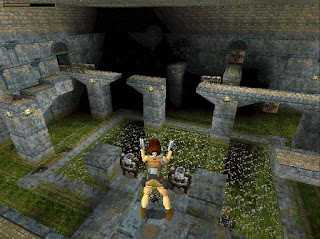
Looking at the mesh above I get the impression that the model has a low polygon count, this is due to lack of curves within the model. The environments within this game seem to be very detailed, like the model of Lara they are also very square. However, they fit the style of the game and pose a high level of detail for the low resolution of game that has been produced. Again, it seems as though the objects within the scene to the left are also box modelled. Some elements seem more detailed and there might have been some extrusion modelling within the more intricate platforms and surfaces.
For Animation purposes: https://www.youtube.com/watch?v=QNZzji8iShM (Skip to 2:00)

Lara Croft (Tomb Raider Legend, 2006)

Ten years later and a move to a new development company, there was a big change in the appearance of Lara Croft.
Doug Church was the designer responsible for creating this version of such a now iconic character within the gaming industry. Church worked for Crystal Dynamics, who took over the development of the Tomb Raider franchise in 2006 and still to this day have full control over the producing of the games.
On the right you can see that compared to the previous (1996) version, the detail is far more apparent.
As well as the polygons being a lot rounder and free flowing. This would lead me to the impression that more extrusion modelling was used for this game. To the left is the 3D Model in more detail, most likely created using Maya. 
You can see the final version, the wire frame version, a close up on the torso as well as the wire framed head. Within this example you can see that far more detail has been put into every aspect of the model. The face mainly has had a vast improvement. The level of detail in the face is pixel perfect, the face would most definitely have been sculpted using extrusion modelling methods. Taking focus onto the torso, the detail within the chest area is far more intricate, rather than a rotated cubed polygon, the designer has manipulated the cube and sculpted it into a more realistic vision of a woman’s chest region.

The environments are a lot clearer and detailed also. You can see the level of detail sculpted into each object, most noticeably the bricks. For this environment I would say that again, there was a mixture of box and extrusion modelling as well as a lot of texturing.
In the image to the right you can also get an angle on how the characters are animated within this game.
The animation is a lot smoother and allows the character to move around the virtual world with a lot more ease. Compared to the 1996 version, the animation is a vast improvement. Both versions work smoothly and well, although Tomb Raider Legend, being a more modern game, moves with more freedom and flexibility.
For a look at the animation visit: https://www.youtube.com/watch?v=WDEQqAXghvk

Lara Croft (Tomb Raider, 2013)
Still being developed by Crystal Dynamics they decided to change the entire face of the game. Darrell Gallagher, the head of Crystal Dynamic Studios said: "Forget everything you knew about Tomb Raider, this is an origins story that creates Lara Croft and takes her on a character defining journey like no other".

With this being said you can notice a drastic change in Lara’s appearance. Again, compared to the previous model I analysed you can see that the level of detail has significantly improved. Now if you compare the version of Lara on the left to the 1996, original, version then you can see the detail has dramatically improved.

You can compare the level of detail in the very first illustrative example.

I wasn’t able to find a wire frame example of the latest version of Lara, however on the right there is four different views of the model.
There is a view of each angle, front, back and both right and left sides.
Even without a wire frame I can tell that this particular model was made almost entirely from extrusion modelling. There is far too much detail for the basis of this to be made using box modelling only. However they may have used box modelling in some aspects.

With the detail being extremely more significant the animation alongside it is also very well implemented and portrayed into the game play.
To view the animation go to https://www.youtube.com/watch?v=hXY5sOGu_C8

In terms of the environment you can also see a high level of improvement in the detail. On the left you can see the elements of the background behind the cliff face. This is a high level of detail, even with being far away from that point of the world you can still see the detail of it. This doesn’t replace the detail of closer range. The mountain face has a very high level of detail with all of the creases and moss. You can also see the lighting and shadowing on the edge of the mountains and behind the trees.

Wednesday, 30 September 2015

3D Landscape Concepts

What is a 3D Landscape?

A 3D Landscape is a virtual open space with 3D models of various objects such as trees, waterfalls, rocks, etc. There are multiple different pieces of software you can install to your computer that can help you create or generate your very own 3D landscape. A few examples of this could be game engines such as Unreal or Unity. These engines have their own built in environment sculpting tools. Alternative you could use other industry standard software such as Maya, 3D Studio Max or ZBrush.


Creating a landscape, especially within a game, gives the overall look and feel of the game more depth. It shows more detail as well as a professional and clean look.

There are many elements needed within a 3D landscape, as well as some not as important, but also very effective elements.

Flooring: Typically grass, however it could be gravel, sand, mud, snow, water, or any other surface that could cover the ground. It could also be a mixture of these.
Trees: Not a necessity but they add dimension and appeal to the environment, it gives a larger environment a smaller feel. They also make the environments look more detailed.


Buildings: Not necessarily buildings that can be accessed, however buildings give a greater depth and feel the environment. As well as this, buildings can often change a somewhat recognizable space and make it almost iconic to the human eye. 

Stones/Rocks/Mountains/Cliffs: Dependent on the environment being portrayed mountains and cliff edges can set a scene apart from all others. More commonly stones and rocks add the little pieces of detail that a landscape often needs.

Creating my own Landscape:

Last week, I made a simple building with basic lighting. This week, I began to add a landscape around it.


Above is the building I started to create previously, around it you can see the grass i added to start sculpting my environment.


Once I was ready to begin sculpting some hills, I selected my brush size.


By dragging my brush I was able to make a series of hills surrounding my building.